Three days is enough for a rewarding first visit to Kyoto if you organize the city by area. The most efficient plan is to spend one day in eastern Kyoto, one in Arashiyama and northwestern Kyoto, and one around Fushimi and central Kyoto. This keeps most journeys between stops under 45 minutes and avoids crossing the city repeatedly.
This itinerary covers Kiyomizu-dera, Gion, Arashiyama Bamboo Grove, Kinkaku-ji, Ryoan-ji, Fushimi Inari Taisha, Nijo Castle and Nishiki Market. It is designed for first-time visitors who are comfortable walking for much of the day and using trains, the subway and occasional buses.
Three-day Kyoto itinerary at a glance
Day | Area | Main stops | Approximate active sightseeing time | Route logic |
|---|---|---|---|---|
1 | Eastern Kyoto | Kiyomizu-dera, Sannenzaka, Ninenzaka, Yasaka Shrine, Kennin-ji and Gion | 8–10 hours | Mostly downhill or level walking after Kiyomizu-dera |
2 | Western and northwestern Kyoto | Arashiyama Bamboo Grove, Tenryu-ji, Togetsukyo Bridge, Ryoan-ji and Kinkaku-ji | 9–10 hours | Groups Kyoto's western sights into one journey |
3 | Southern and central Kyoto | Fushimi Inari, Nijo Castle, Nishiki Market and central shopping streets | 8–9 hours | Uses rail and subway for the longer connections |
The schedule assumes you are staying near Kyoto Station, Shijo-Kawaramachi or another central transport hub. Transit times are planning allowances rather than timetable guarantees. Add extra time during cherry-blossom season, autumn foliage, weekends and public holidays.
Day 1: Kiyomizu-dera, historic streets and Gion
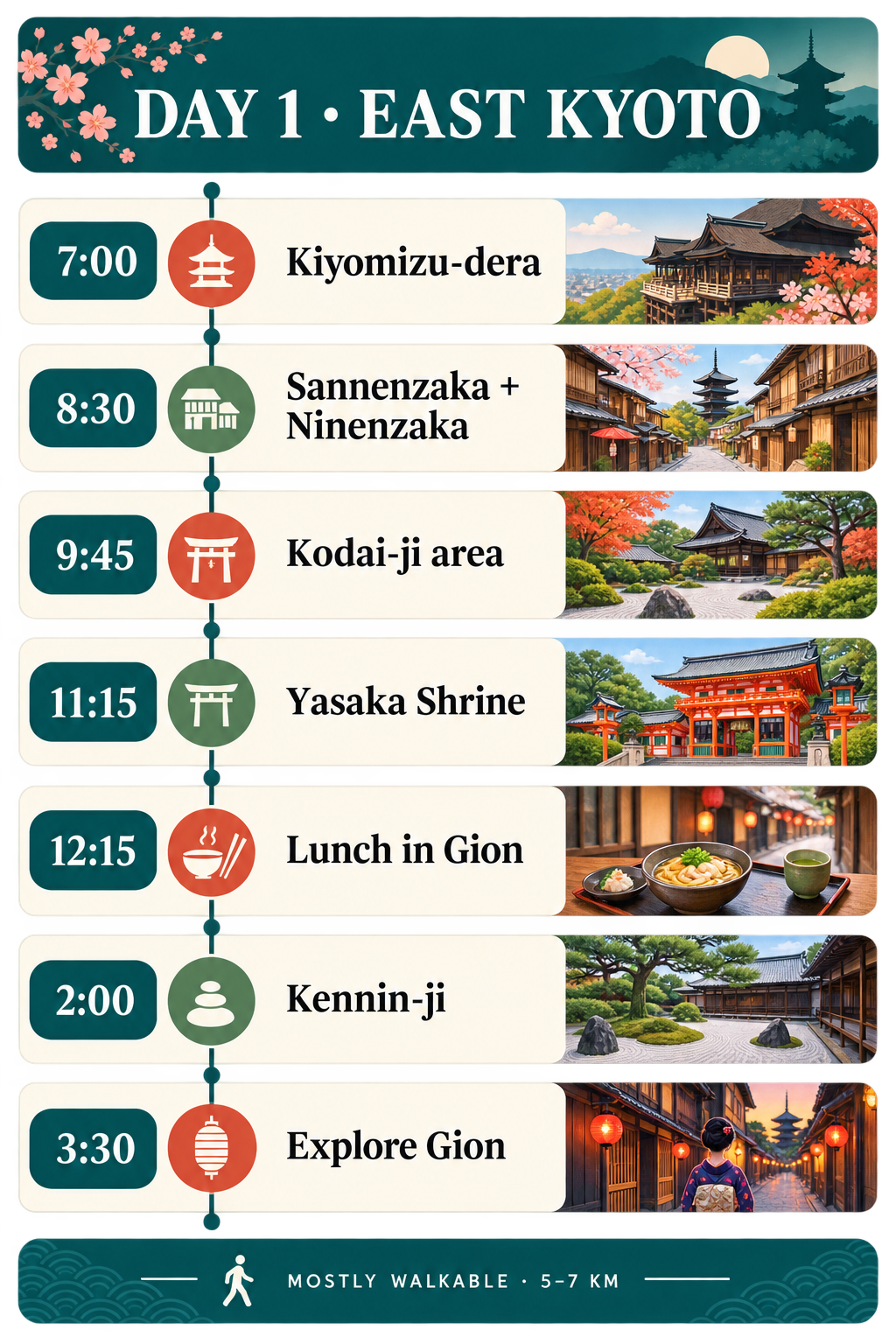
Route: Kiyomizu-dera → Sannenzaka → Ninenzaka → Kodai-ji area → Yasaka Shrine → Kennin-ji → Gion
- Recommended start: 7:00–7:30 a.m.
- Walking: Approximately 5–7 kilometres, depending on detours
- Why this route works: After reaching Kiyomizu-dera, almost the entire day unfolds through connected eastern neighborhoods.
7:00 a.m. — Begin at Kiyomizu-dera
Allow 75–90 minutes for the temple complex and its viewpoints. Kiyomizu-dera officially opens at 6:00 a.m., although closing times change by season and during special evening openings. An early visit gives you more room on the approach and allows the rest of the day to flow downhill toward Gion.
Do not schedule another timed attraction immediately afterward. The uphill approach, photography and congestion can easily add 20–30 minutes.
Check the official Kiyomizu-dera opening calendar before visiting.
8:30 a.m. — Walk through Sannenzaka and Ninenzaka
Allow 60–75 minutes, longer if you want breakfast or shopping. These preserved streets are part of the experience rather than merely a connection between attractions.
Follow the route downhill instead of taking transport back toward central Kyoto. This naturally leads toward the Kodai-ji and Yasaka areas.
9:45 a.m. — Kodai-ji area or a slower coffee stop
Choose one of two versions:
- Temple-focused: Visit Kodai-ji and allow approximately one hour.
- Slower version: Explore the surrounding lanes and stop for breakfast or coffee.
Trying to visit every temple in Higashiyama makes the day repetitive. One additional temple is usually enough before continuing toward Gion.
11:15 a.m. — Yasaka Shrine and Maruyama Park
Allow 45–60 minutes. Yasaka Shrine is positioned at the eastern edge of Gion, so it acts as the transition between the historic hillside streets and the flatter entertainment district.
Maruyama Park is worth additional time during cherry-blossom season. Outside peak bloom, move through at a relaxed pace rather than treating it as a major standalone stop.
12:15 p.m. — Lunch in Gion
Reserve 60–90 minutes. Eating here avoids another transport journey and gives you a natural break after the morning's hills and steps.
If a specific restaurant matters to you, check its opening days and reserve where possible. Otherwise, preserve flexibility: a rigid lunch reservation can make the morning unnecessarily rushed.
2:00 p.m. — Kennin-ji
Allow 60–75 minutes. Kennin-ji sits within the Gion area, making it a geographically efficient afternoon temple rather than an isolated excursion.
If you are tired of temples, replace this stop with more time in Gion, a tea experience or a museum. A good itinerary should allow substitution without breaking the route.
3:30 p.m. — Explore Gion without a strict checklist
Walk through Hanamikoji and the surrounding streets, but remember that Gion is a living neighborhood. Follow local signs, do not enter private lanes and never obstruct or pursue residents for photographs.
Continue toward the Shirakawa area or the Kamo River as the afternoon cools. Pontocho is an easy dinner area across the river, although individual restaurants vary greatly in price and reservation requirements.
Day 1 timing table
Time | Stop | Suggested duration | Travel to next stop |
7:00 a.m. | Kiyomizu-dera | 75–90 min | 5–10 min walk |
8:30 a.m. | Sannenzaka and Ninenzaka | 60–75 min | 10–15 min walk |
9:45 a.m. | Kodai-ji area | 60 min | 10 min walk |
11:15 a.m. | Yasaka Shrine and Maruyama Park | 45–60 min | 5–15 min walk |
12:15 p.m. | Lunch in Gion | 60–90 min | 5–10 min walk |
2:00 p.m. | Kennin-ji or alternative | 60–75 min | Already in Gion |
3:30 p.m. onward | Gion, Shirakawa and dinner | Flexible | — |
Day 2: Arashiyama, Ryoan-ji and Kinkaku-ji
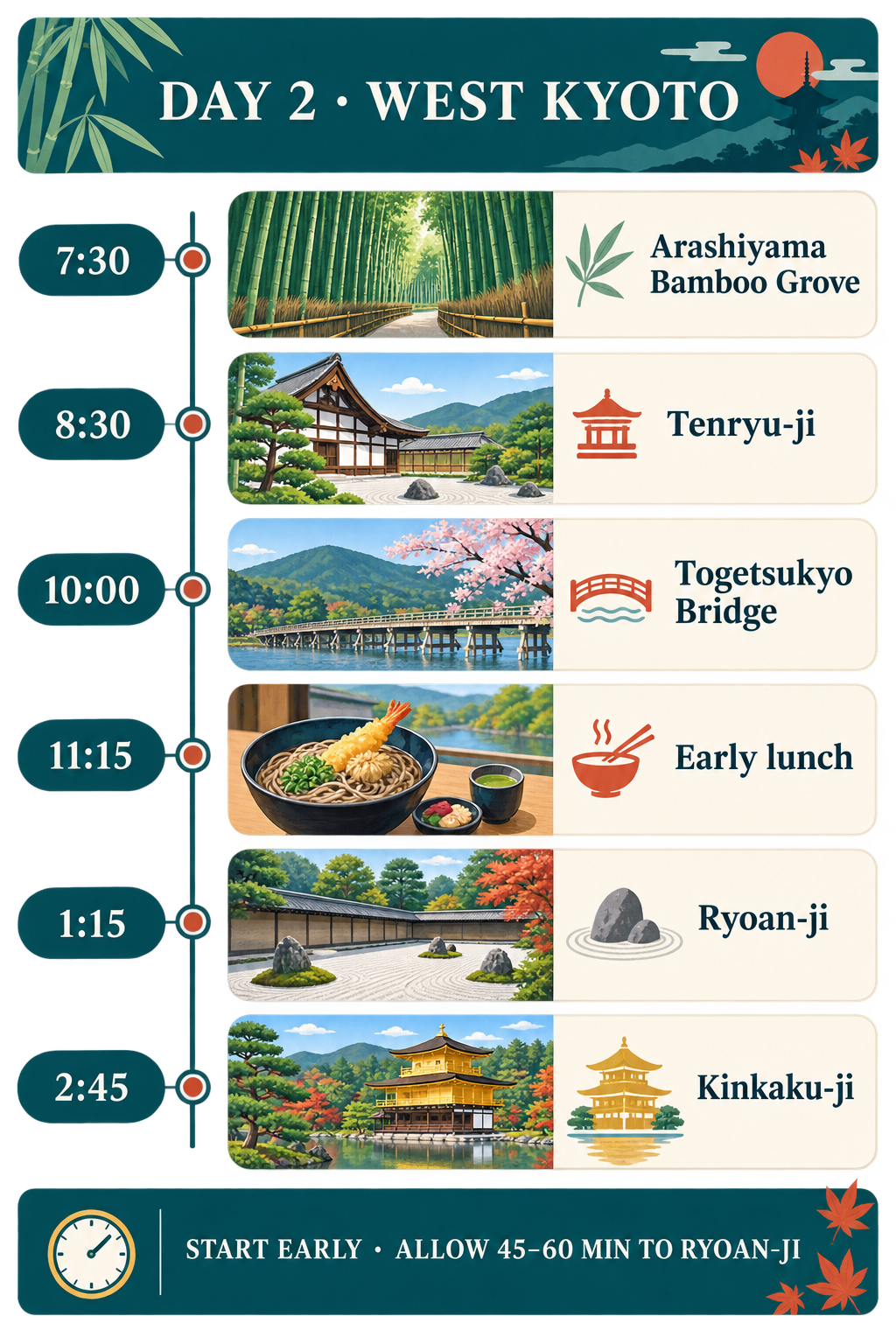
Route: Arashiyama Bamboo Grove → Tenryu-ji → Togetsukyo Bridge → Ryoan-ji → Kinkaku-ji
- Recommended start: 7:00–7:30 a.m.
- Walking: Approximately 6–8 kilometre
- Why this route works: Arashiyama lies well west of central Kyoto. Combining it with the Kinugasa temple area prevents a second cross-city trip on another day.
7:30 a.m. — Arashiyama Bamboo Grove
Allow 30–45 minutes for the main grove. The path is relatively short; the larger time commitment comes from reaching Arashiyama and visiting the surrounding district.
Arrive before the nearby temples open. This lets you experience the outdoor paths first rather than using prime morning time in transit. Arashiyama is one of Kyoto's most visited areas, so an early start matters more than squeezing in another attraction.
Kyoto's official tourism guide recommends checking its congestion forecast and live information when planning visits to popular areas.
8:30 a.m. — Tenryu-ji and its garden
Allow 60–75 minutes. Enter after the bamboo grove and spend time in the garden rather than racing through it.
Opening hours can vary seasonally, so confirm them on the attraction's official page before publication and again before travel.
10:00 a.m. — Togetsukyo Bridge and the riverside
Allow 45–60 minutes. This is also the best point for a coffee or early snack before leaving Arashiyama.
Do not add the Monkey Park automatically. It can be worthwhile, but the uphill walk and visit require roughly two additional hours. If you include it, remove either Ryoan-ji or Kinkaku-ji rather than compressing every stop.
11:15 a.m. — Early lunch in Arashiyama
Reserve approximately 60 minutes. Eating early reduces the chance of losing time in peak lunch queues and prepares you for the day's least convenient connection.
12:15 p.m. — Travel to Ryoan-ji
Allow 45–60 minutes, including waiting and walking. The exact combination depends on your starting point and live service. Check the route on the morning of travel.
Kyoto's official transport advice recommends combining trains, subway and buses instead of relying on buses alone. Rail is usually the more predictable choice for the longer cross-city portions. See the city's getting-around guidance.
1:15 p.m. — Ryoan-ji
Allow 60–75 minutes for the rock garden and wider grounds. Ryoan-ji and Kinkaku-ji are in the same broad northwestern area, which makes them sensible companions.
2:45 p.m. — Continue to Kinkaku-ji
Allow approximately 20–30 minutes for the connection and 60 minutes at Kinkaku-ji. The visitor route is structured and does not normally require several hours.
Kinkaku-ji is one of Kyoto's most recognizable landmarks, but it is not directly beside a rail station. Keeping it on the same day as Ryoan-ji is more efficient than making a separate journey from eastern Kyoto.
Read the Kyoto City tourism entry for Kinkaku-ji and verify current admission hours before visiting.
4:15 p.m. — Return to central Kyoto
Keep the evening flexible. You will have already completed the itinerary's longest sightseeing day. Use the evening for dinner near your hotel, Kyoto Station or central Kawaramachi rather than adding another distant attraction.
Day 2 timing table
Time | Stop | Suggested duration | Travel to next stop |
7:30 a.m. | Arashiyama Bamboo Grove | 30–45 min | 5–10 min walk |
8:30 a.m. | Tenryu-ji | 60–75 min | 10–15 min walk |
10:00 a.m. | Togetsukyo Bridge and riverside | 45–60 min | Nearby |
11:15 a.m. | Early lunch | 60 min | 45–60 min to Ryoan-ji |
1:15 p.m. | Ryoan-ji | 60–75 min | 20–30 min to Kinkaku-ji |
2:45 p.m. | Kinkaku-ji | 60 min | 35–60 min to central Kyoto |
Evening | Dinner near hotel | Flexible | — |
Day 3: Fushimi Inari, Nijo Castle and Nishiki Market
Route: Fushimi Inari Taisha → Nijo Castle → Nishiki Market → Teramachi and Shinkyogoku
- Recommended start: 7:00 a.m.
- Walking: Approximately 6–9 kilometres, depending on the Fushimi Inari route
- Why this route works: An early shrine visit is followed by timed central attractions and a flexible final afternoon.
7:00 a.m. — Fushimi Inari Taisha
Allow 90 minutes for the main shrine and lower torii-gate route. Allow 2.5–3 hours if you intend to complete the longer mountain circuit.
The most common scheduling mistake is writing “Fushimi Inari: one hour” without explaining how far the traveler plans to walk. The lower shrine precincts and famous gate corridors require much less time than the full ascent.
Fushimi Inari is directly accessible by rail, and the shrine recommends public transport because surrounding parking can become crowded. Check the official access information.
If you choose the full mountain route, remove Nijo Castle or move Nishiki Market later. Do not expect the standard schedule below to remain comfortable.
9:00 a.m. — Travel to Nijo Castle
Allow approximately 45–60 minutes, including transfers and walking. This is the longest movement of the day, but it positions you in central Kyoto for the remaining stops.
10:15 a.m. — Nijo Castle
Allow 90 minutes to two hours. Check the official calendar carefully: admission schedules, closure dates and access to individual palace areas can differ.
This is the day's most time-sensitive attraction. Visit before lunch, then keep the afternoon flexible.
Consult the official Nijo Castle website for current hours, closures and ticket information.
12:30 p.m. — Lunch near Nijo or Nishiki
Allow 60 minutes. If your priority is sampling several market foods, have only a light lunch before Nishiki.
1:45 p.m. — Nishiki Market
Allow 60–90 minutes. Nishiki is a 390-metre shopping street with individually operated stores, not a single attraction with one universal timetable. The market association notes that shop hours and holidays vary, and that many businesses may close on Wednesdays.
Do not walk while eating. The market association asks visitors to eat at or in front of the shop where food was purchased.
Use the official Nishiki Market store directory to check any must-visit shop rather than relying on a single market-wide opening time.
3:15 p.m. — Teramachi and Shinkyogoku
These covered shopping streets connect naturally with the Nishiki area. Spend 60–90 minutes here or use the time to return to a missed central attraction.
This flexible ending is intentional. Weather, queues and fatigue accumulate over a three-day trip; an itinerary with no recovery margin is likely to fail.
Day 3 timing table
Time | Stop | Suggested duration | Travel to next stop |
7:00 a.m. | Fushimi Inari lower route | 90 min | 45–60 min to Nijo Castle |
10:15 a.m. | Nijo Castle | 90–120 min | 10–20 min to lunch area |
12:30 p.m. | Lunch | 60 min | Walk or short transit |
1:45 p.m. | Nishiki Market | 60–90 min | Adjacent streets |
3:15 p.m. | Teramachi and Shinkyogoku | 60–90 min | — |
Evening | Final dinner or missed stop | Flexible | — |
Is this Kyoto itinerary actually doable?
Yes. This itinerary is achievable for most active travelers because it groups stops by area and limits the plan to two or three major attractions per day. It is not designed for someone who wants to complete the full Fushimi Inari mountain circuit, climb to the Arashiyama Monkey Park and enter every temple listed along the route.
The plan becomes rushed if you:
- Start after 9:00 a.m. each day.
- Spend more than two hours taking photographs at each major site.
- Add distant attractions without removing anything.
- Depend exclusively on city buses during congested periods.
- Book inflexible meals between timed attractions.
- Attempt the full Fushimi Inari climb within the standard Day 3 schedule.
How to adapt the itinerary to your travel style
For slower travelers
Remove one attraction each day:
- Day 1: Skip Kennin-ji.
- Day 2: Choose Ryoan-ji or Kinkaku-ji, not both.
- Day 3: Skip Nijo Castle if completing more of the Fushimi Inari trail.
For families with young children
Avoid treating early starts as mandatory every day. Preserve Day 1's downhill route, spend more time around Arashiyama on Day 2 and choose the shorter Fushimi Inari route on Day 3. Build in a substantial afternoon break.
For travelers who dislike crowds
Prioritize Kiyomizu-dera and Arashiyama's outdoor paths early. Check Kyoto's official congestion forecast before fixing the order of days. A quieter weekday may be more valuable for Arashiyama than following this sequence literally.
For temple enthusiasts
Replace central shopping time with another temple in an already scheduled district. Do not add a distant temple merely because it appears on a “must-see” list.
During cherry-blossom or autumn-foliage season
Expect slower transport, denser walking routes and longer meal waits. Remove one optional stop per day and verify special opening schedules. Kyoto's official guide notes that autumn foliage periods are crowded and recommends using its comfort map and live cameras.
Where should you stay for this itinerary?
The easiest bases are:
- Kyoto Station: Best for rail connections to Fushimi Inari, Arashiyama and onward travel.
- Shijo-Kawaramachi: Best for restaurants, evening atmosphere and walking access to Nishiki and Gion.
- Karasuma area: A practical compromise with central subway access and a calmer evening environment.
Do not choose a hotel solely because it looks close on a map. Check walking distance to a useful rail or subway station and the number of transfers required for your first morning.
What to book before arriving
Prioritize reservations that can determine the day:
- Any palace-area admission or special access required at Nijo Castle.
- A specific restaurant you would be disappointed to miss.
- Seasonal special viewings or ticketed events.
- Experiences with fixed start times, such as tea ceremonies or guided tours.
Kiyomizu-dera, Fushimi Inari and the Arashiyama Bamboo Grove should still be checked for current visitor notices, but the standard route is primarily controlled by arrival time rather than a conventional timed-entry slot.
Kyoto transportation tips for this route
- Use rail for Fushimi Inari and Arashiyama when it suits your starting point.
- Use the subway for reliable north–south and central connections.
- Treat buses as connectors, not the default for every journey.
- Use an IC card for convenience, but calculate separately whether a day pass fits your actual route.
- Check live directions before each long transfer; the best route can change with service and congestion.
- Avoid bringing large luggage on sightseeing days. Kyoto's official guide promotes luggage-storage and hands-free travel options.
Frequently asked questions
Are three days enough for Kyoto?
Three days are enough to see Kyoto's principal first-time attractions without rushing, provided you group them by area. Four or five days are better if you want slower mornings, the full Fushimi Inari climb, additional temples or day trips outside the city.
Is it better to stay in Kyoto or Osaka for this itinerary?
Stay in Kyoto if these three sightseeing days are your priority. Commuting from Osaka adds travel at the beginning and end of every day and makes the early starts at Kiyomizu-dera, Arashiyama and Fushimi Inari less convenient.
Do you need a car in Kyoto?
No. A car is unnecessary for this itinerary and can be less convenient around crowded attractions with limited parking. The route is designed for trains, subway, buses and walking.
Can you visit Fushimi Inari and Arashiyama on the same day?
It is possible, but it is not the most efficient first-time plan. The two attractions sit on different sides of Kyoto. Visiting them on separate days lets you combine each with nearby sights and reduces cross-city travel.
Should you buy a Kyoto transport pass?
Not automatically. The best value depends on which operators and modes you use that day. Compare the pass coverage with your planned rail, subway and bus journeys rather than buying it solely for convenience.
What is the best day of the week for this itinerary?
There is no universally quiet day, but weekdays generally make the busiest sightseeing areas easier to manage. Check closure schedules before assigning Nijo Castle, individual temples or specific Nishiki Market shops to a particular day.
Build a Kyoto itinerary around your pace
No fixed itinerary works equally well for someone who photographs every temple, a family that needs afternoon breaks and a traveler who wants to hike all of Mount Inari.
Use Travinora to build a Kyoto plan around your available days, preferred experiences and realistic transit time—then see whether the schedule fits before you arrive.
Data check
Based on Travinora's live inventory, checked August 2026.
Discover real, bookable experiences in Kyoto — honest prices and ratings, never a sponsored spot.
Explore destinations